What is a PLC?
The component that runs almost every modern machine — and the one most technicians never get a straight answer about.
Watch Full Lesson
Student Guide (PDF)
Printable companion to EP001 — key diagrams, definitions, and field checks in one PDF.
Download Student Guide (PDF) ↓Knowledge Check
Five quick questions to check what stuck. Reveal answers as you go — no score tracking, no pressure.
Start Knowledge Check (OCG-Q001) →Concept
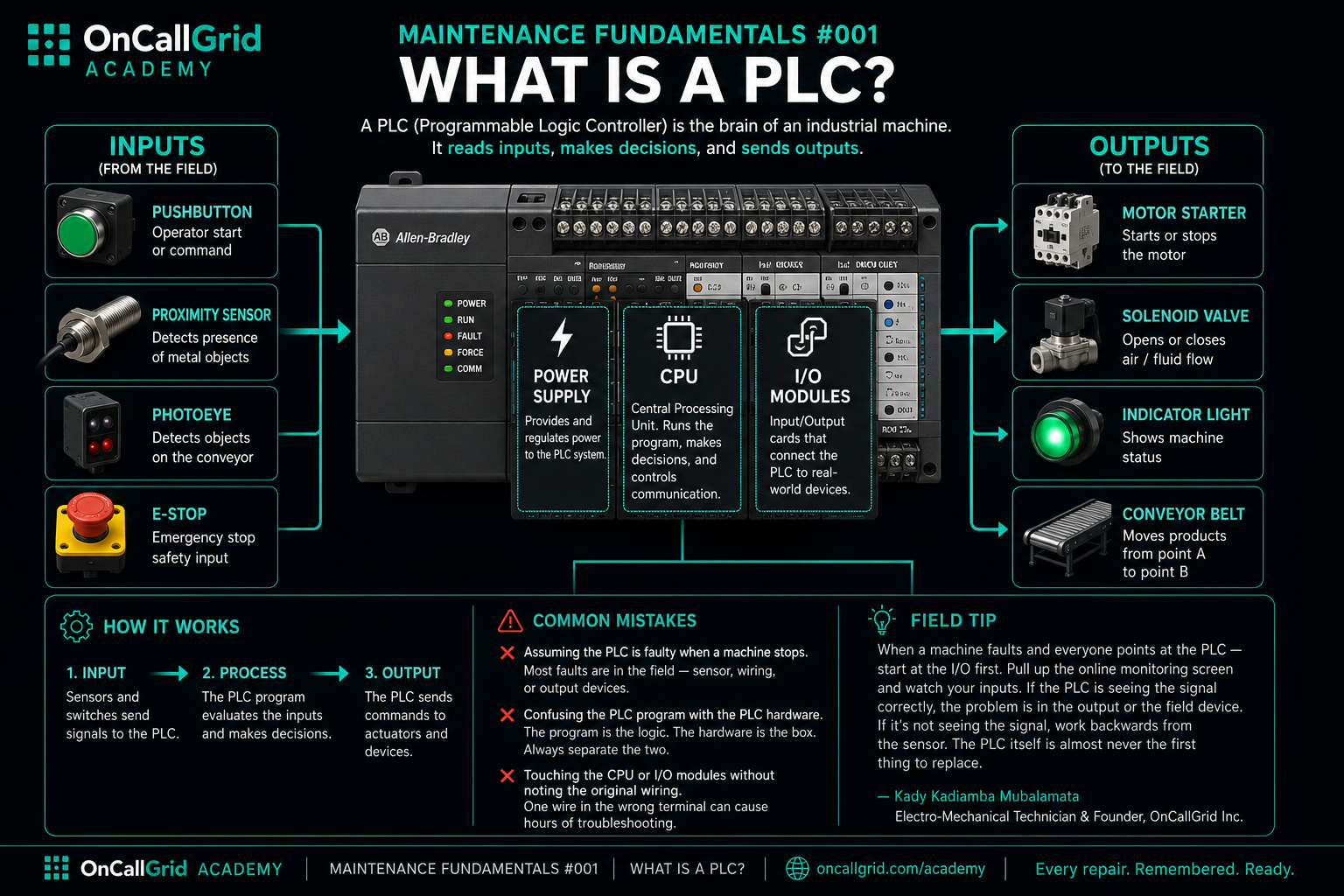
A PLC — Programmable Logic Controller — is a small industrial computer purpose-built to run a single job: read signals from the real world, make a decision based on a program, and switch outputs on or off. That's it. Everything else is detail.
Think of it as the brain that sits between your sensors and your actuators. A button gets pressed, a proximity switch sees a part arrive, a temperature sensor crosses a threshold — the PLC reads all of that, checks its program hundreds of times a second, and decides what should happen: start the conveyor, open the valve, fire the alarm.
Unlike a desktop PC, a PLC is built to live in a panel for 20 years — vibration, heat, electrical noise, dust, no fan. It runs the same program forever, deterministically, on a fixed scan cycle.
Inside the Machine
Every PLC has the same four parts, no matter the brand:
- CPU — the processor that executes your program, one rung at a time, top to bottom, over and over.
- Memory — holds the program (what to do) and the data (current input/output states, timers, counters, setpoints).
- I/O modules — the input module reads field signals (24 VDC from a sensor, 4–20 mA from a transmitter); the output module switches relays, contactors, or solenoids.
- Power supply — usually 24 VDC to the logic, separate from whatever drives the loads.
The PLC runs a scan cycle: read all inputs → execute the program → write all outputs → repeat. A typical cycle is 5–50 ms. That determinism is why PLCs run safety-critical equipment and PCs don't.
Common Mistakes
- Calling it “the computer.” A PLC is not a PC. It has no operating system in the way you think, no apps, no browser. Treating it like a computer leads you to look for the wrong faults.
- Assuming the output is dead because the light is off.The output LED on the card shows what the PLC commanded, not what the field device actually did. Always meter the load side.
- Blaming the PLC first. In 20 years of field work, the PLC itself fails maybe 1 time in 100. The other 99 are wiring, field devices, power, or grounding. Suspect the panel and the cable before you suspect the processor.
- Ignoring the scan time. If a fault appears and disappears in less than one scan, the PLC will never see it. That's not a PLC problem — that's a logic-and-latching problem.
Field Tip
“Before you ever open the PLC program, walk the panel. Verify power on the supply, verify the input LED matches the field state, and verify the output LED matches what the load is doing. Nine times out of ten, the answer is on the terminal strip, not in the code. The PLC almost always tells you the truth — you just have to ask it the right question.”